A 30 square tear-off does not have one price. The same roof is worth one number to a homeowner paying cash, another to an insurance carrier, another on a general contractor's bid form, and the rules change again when the job is a two hour leak repair. Contractors who run every job through one price-per-square habit end up strong on one kind of work and thin on the rest.
This post walks through the four ways a roofing estimate gets priced: retail, insurance, commercial and repair. For each one it covers what the price is built from, who decides the number, and the mistake that most often costs margin.
Why one pricing method does not fit every job
Every roofing estimate starts from the same facts. Squares of field, LF of eave, rake, ridge, hip and valley, the pitch, the count of penetrations. What changes is how those quantities turn into a price and who has the final say on it.
- Retail: you set the price. The customer compares it to other bids.
- Insurance: the carrier's price list sets unit prices. The scope is negotiated line by line.
- Commercial: the plans and specs set the scope. The low qualified bid usually wins.
- Repair: the visit sets the price. Material is a small part of it.
The quantities are shared. The math on top of them is not. That is why a company that does more than one kind of work needs more than one pricing method.
Retail: your cost plus your margin
A retail estimate is built from your own costs. Material at your supplier's pricing, labor at what you pay your crew or sub per square, disposal, permit, and any equipment. Then overhead and profit go on top.
The most common retail mistake is confusing markup with margin. They are not the same number. Take a job with $10,000 in direct cost:
- A 40% markup gives a price of $14,000. The margin on that sale is $4,000 divided by $14,000, or about 28.6%.
- A 40% margin needs a price of about $16,667, because $10,000 is 60% of the sale.
That is a $2,667 difference on one roof from one word. Decide which one your company uses, write it down, and make sure every salesperson prices the same way.
Other points that matter on a retail estimate:
- Price per square is a check, not a method. A steep, cut-up roof with four valleys and a chimney costs more per square than a simple gable. Build the estimate from line items and use price per square only to sanity check it.
- Price the accessories. Starter, ridge cap, drip edge, ice and water shield, pipe boots and step flashing are where a rough estimate comes up short.
- Offer options. Good, better and best shingle lines let the homeowner choose up instead of asking you to come down.
- Allow for decking. State a per-sheet price for replacing bad decking so it is not a fight after tear-off.
Insurance: the price list sets the unit price
On an insurance job you do not set the unit prices. The carrier pays from a price list for your area, line item by line item: tear-off per square, shingles per square, drip edge per LF, pipe jack flashing each, and so on. If your estimate uses the same line items and units as the adjuster's, the two can be compared side by side.
That changes where the margin comes from. On a retail job you protect margin with price. On an insurance job you protect it with scope and with your own cost.
- Scope: every item that is on the roof and has to be replaced needs to be on the estimate. Starter, ridge cap, drip edge, valley metal, step flashing, vents, steep and high charges where they apply, and code-required items. A line that is missing from the scope is work you do for free.
- Quantities: measure the roof yourself. If the adjuster's sheet shows 28 squares and the roof is 31, that gap has to be documented and supplemented.
- Your cost: the price list total is your revenue. Your real material and labor cost is still your own. Run the job against a budget like any other so you know what it made.
The common mistake is treating the carrier's first estimate as the final number, then finding the missing items during the build. Compare scopes before the job is scheduled, and track every supplement to an answer. An earlier post covers tracking an insurance roofing job from claim to final payment.
Commercial: bid from the plans and specs
A commercial estimate is a bid on a defined scope. The drawings and the spec section tell you the system: TPO, PVC or mod-bit, the membrane thickness, the insulation layers and R-value, the attachment method, the edge metal and the warranty. You do not get to choose the product line. You get to price it right.
Commercial pricing is built in more layers than a residential job:
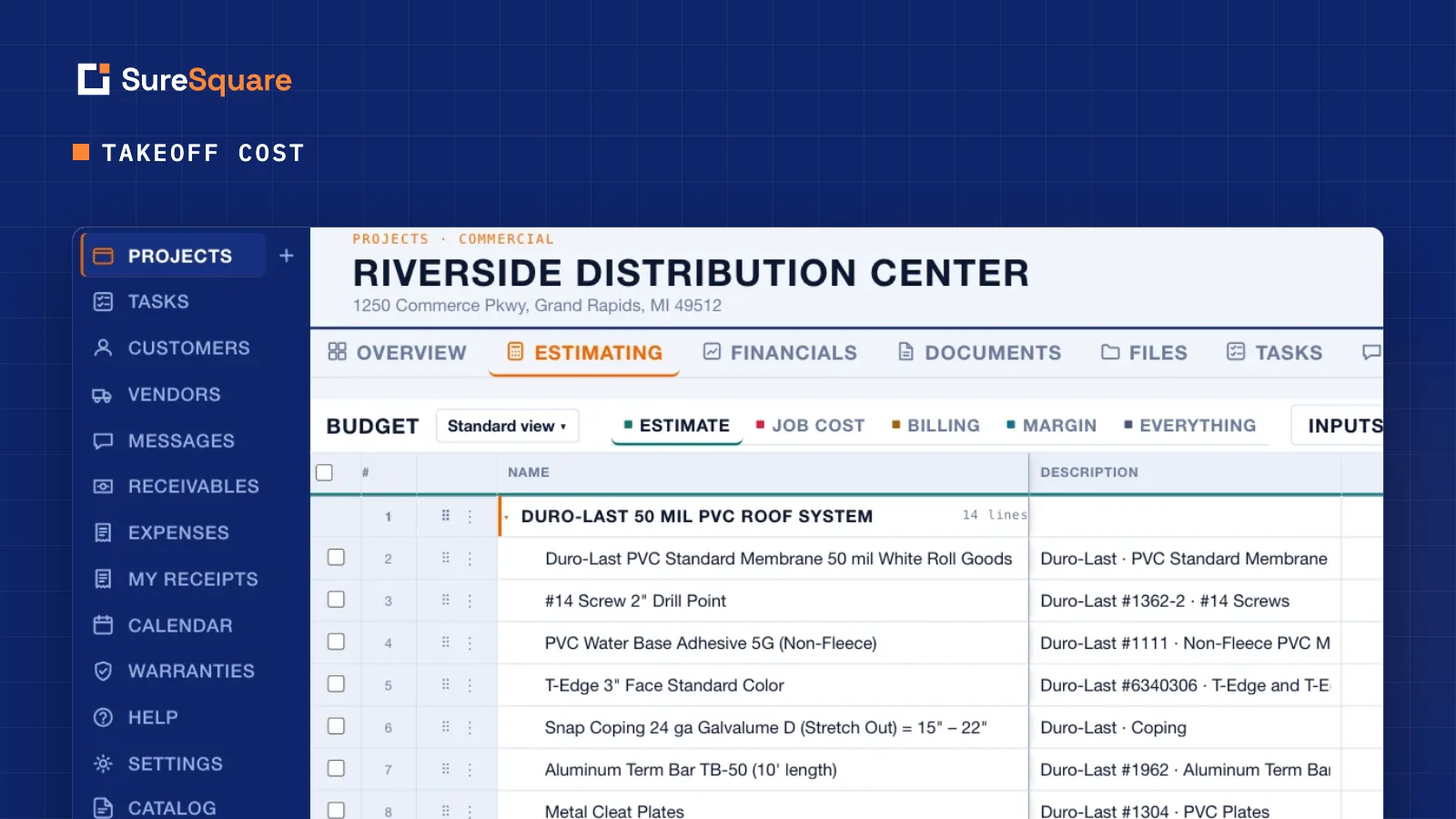
- Material from a takeoff: membrane by roll, insulation by board, fasteners and plates by the attachment pattern, adhesive by coverage rate, plus flashing, coping, drains and curbs counted from the plans.
- Labor by production rate: squares per day for the field, with separate time for parapet walls, curbs, penetrations and edge metal. Detail work is slower than field work and should be priced that way.
- General conditions: mobilization, crane or hoist, safety, dumpsters, supervision and temporary protection.
- Job-level costs: manufacturer warranty fees, permit, bond and insurance requirements when the bid documents call for them.
- Alternates and unit prices: many bid forms ask for add or deduct alternates and a unit price for items like wet insulation replacement.
The margin killer on commercial work is the missed item, not the markup. A parapet that was not measured, a second layer of insulation, or an addendum that changed the membrane can erase the profit on a job you priced tightly to win. Quantities are estimates and should be checked against the documents before you sign a bid. Our estimating disclaimer explains how takeoff quantities should be used.
Repair: price the visit, not the squares
A repair is the one job where price per square makes no sense. Replacing six shingles and a pipe boot uses very little material. The real cost is a truck, a roofer, the drive, the setup and the time to find the leak.
Repairs are usually priced one of two ways:
- Flat rate with a minimum: a set service charge that covers the trip and the first hour, then fixed prices for common repairs such as a pipe boot, a section of flashing or a small patch.
- Time and materials: an hourly rate per person plus materials at a markup, with a minimum charge. This suits leaks where the cause is not known until someone is on the roof.
The mistake here is pricing a repair like a small re-roof. If the minimum does not cover the trip, the office time and the callback risk, every repair loses a little money. State what is included, what is not, and what the customer pays if the problem turns out to be larger.
Mistakes that cost margin on any of the four
- Using one waste factor for every roof, whether it is a simple gable or a cut-up hip roof.
- Pricing from material costs that are months old.
- Leaving out disposal, permit or delivery because they are small.
- Measuring twice in two different tools and getting two different roofs.
- Never comparing the estimate to what the job really cost. A post on roofing job costing, budget vs actual covers how to close that loop.
Measure once, then price it the right way
The measurements do not change with the pricing method. What should change is the price list, the line items and the layers of cost on top. An estimating setup that keeps the quantities in one place and lets you price them more than one way saves the rework of rebuilding the job each time.
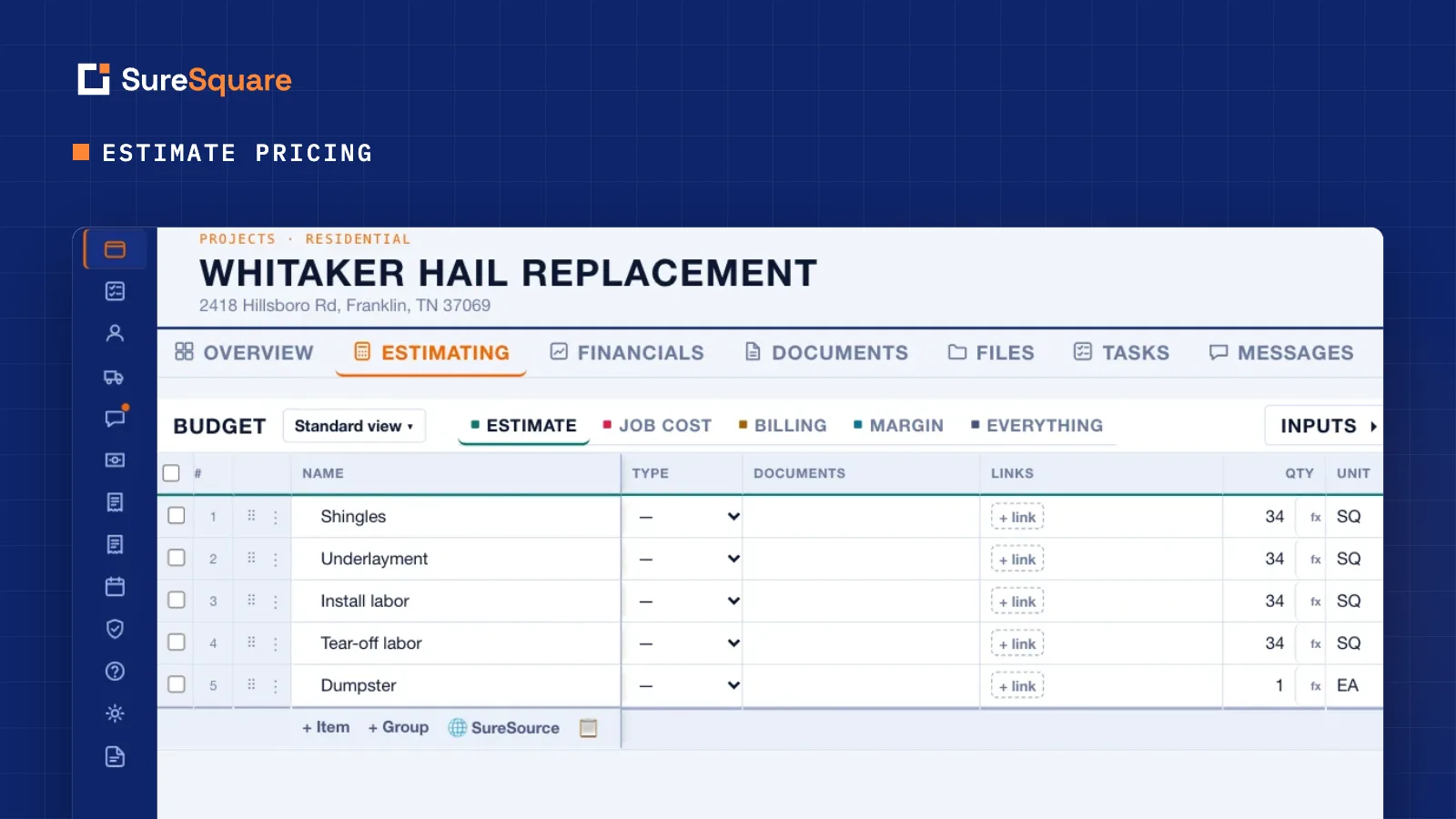
SureSquare CRM is built around that idea. Estimates run on formulas tied to the roof's measurements, and the same job can be priced four ways: retail, insurance, commercial, or repair. If your company does more than one kind of roofing work, it is worth a look at how each of your estimates is priced today and whether the method matches the job.