Every bid starts with a takeoff, and every takeoff costs something, even when no invoice shows up for it. If your estimator spends three hours on a plan set you do not win, you paid for that takeoff in payroll. If you pay for a measuring tool every month and bid four jobs, you paid for it in subscription. The question is not whether a takeoff costs money. It is which way of paying fits how you bid.
This post breaks down the three common ways roofing contractors pay for takeoffs, what drives the price in each one, and how to work out your own cost per bid.
The three ways contractors pay for a takeoff
Almost every roofing company uses one of these, or a mix:
- In-house labor. An estimator, a project manager or the owner measures the plans. The cost is their time.
- Software subscription. You pay monthly or yearly for a takeoff tool and still do the measuring yourself. The cost is the subscription plus the time.
- Per-project service. You send the plans out and get a finished quantity report back. The cost is a set price per job.
None of these is wrong. They just put the cost in different places, and the right one depends on your bid volume, the kind of roofs you bid and who would be doing the measuring otherwise.
What an in-house takeoff really costs
The in-house number is easy to underestimate because it never appears as a line item. To find it, you need two figures: the loaded hourly cost of the person measuring, and the hours a takeoff actually takes them.
Loaded cost is wage plus payroll taxes, insurance and benefits. Hours should include everything, not just the measuring: downloading the plan set, finding the roof sheets, reading the spec section, checking details, measuring, building the quantity list and checking it.
Here is the math as an example, with made-up numbers you should replace with your own. Say the person measuring costs you $45 an hour loaded. A simple residential plan takes them one hour. A commercial low-slope plan set with a taper plan, parapets and a page of details takes them four. That is $45 for the house and $180 for the commercial job, before anyone has priced anything.
Then apply your win rate. If you win one bid in four, the takeoff cost of each job you win is really four takeoffs. In the example, the commercial job you landed carried $720 of measuring time across the bids it took to get it.
There is also the cost you cannot put a rate on. When the owner is the one measuring at 9 p.m., the takeoff is taking time from sales calls, site visits and collections. And when bid day stacks three plan sets on one estimator, something gets measured fast, which is where missed parapet flashing and short ridge counts come from.
What a software subscription really costs
A takeoff tool makes measuring faster and cleaner than a scale ruler and a highlighter. It does not do the measuring. So the true cost is the subscription divided by the number of takeoffs you run, plus the labor from the section above at a somewhat lower hour count.
This works well when volume is steady. A company bidding thirty jobs a month spreads the subscription thin. A company bidding four jobs in a slow month pays the same fee across far fewer bids. If your bidding is seasonal or comes in bursts, work out the cost per takeoff in your slowest month, not your busiest.
Also count the learning time. Someone has to know the tool well enough to set scale correctly on every sheet, and a wrong scale is a wrong number on every line.
What a per-project takeoff service costs
With a per-project service, the price is known before you send the plans. You pay for the jobs you bid and nothing in the months you do not. What you get back varies by service level, so compare what is in the report, not just the price.
As a reference point, SureSquare's takeoff service is priced per project with no contract and no subscription. These are introductory prices, and commercial pricing applies to any commercial building, including a shingle roof on one:
- Takeoff only: $29 residential, $45 commercial. Roofing quantities with waste factors, for contractors who price in-house.
- Takeoff + Materials: $49 residential, $149 commercial. The takeoff plus material quantities by system and a material summary.
- Full Estimate: $69 residential, $195 commercial. Takeoff, material quantities and labor quantities in a bid-ready format.
Every level is measured by a U.S. estimator from your plan set and comes back as a PDF and CSV report. The full list is on the takeoff pricing page.
What pushes the price of a takeoff up
Whether you pay in hours or in dollars, the same things make a takeoff cost more. Knowing them helps you budget and helps you spot a price that is too good to cover the work.
Residential or commercial
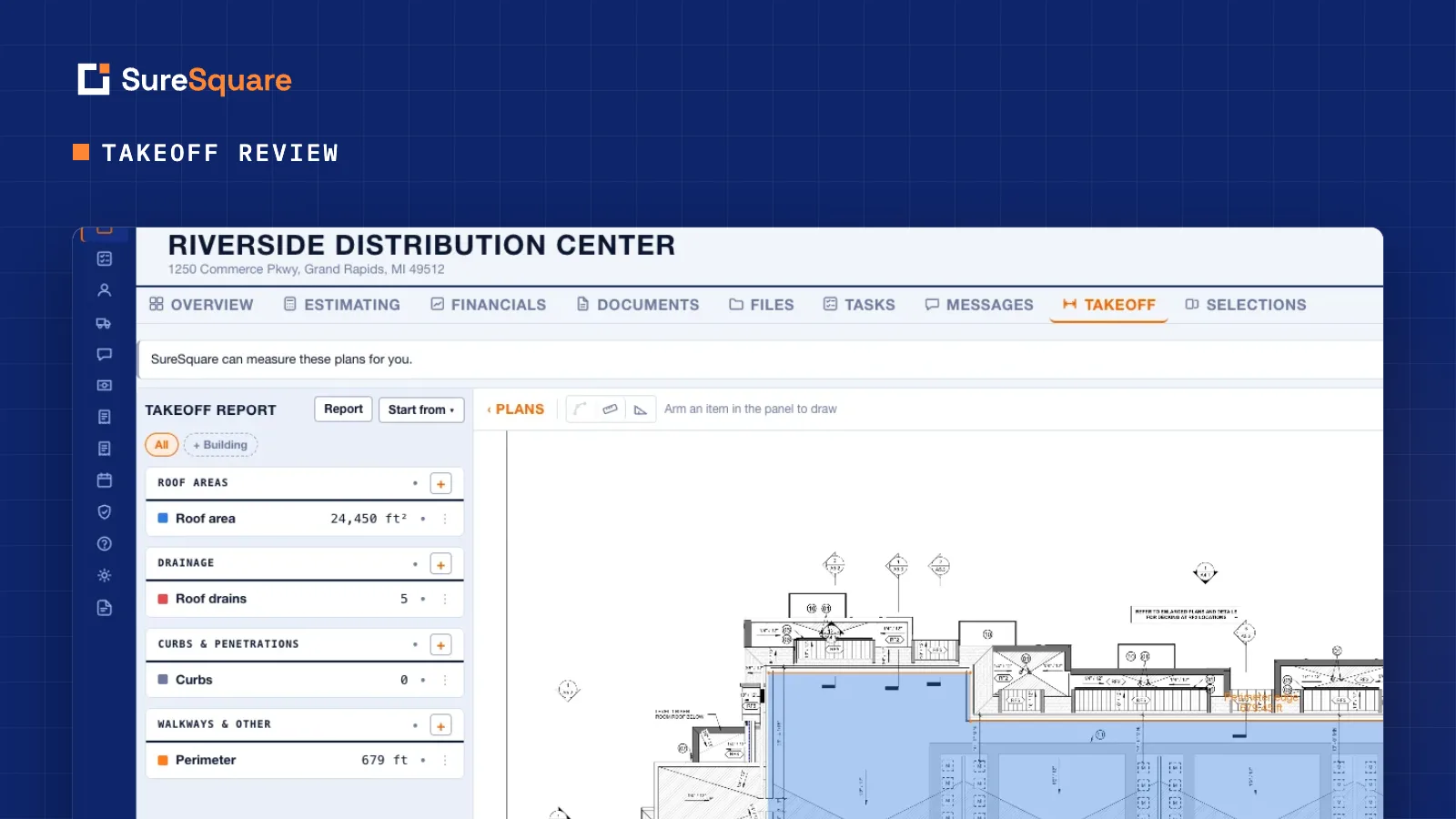
A house is a roof plan and a few elevations. A commercial job is a roof plan, a spec section, a detail sheet, often a taper plan and sometimes structural and plumbing sheets that affect the roof. More sheets to read means more time, which is why commercial work is priced higher almost everywhere.
How much you want back
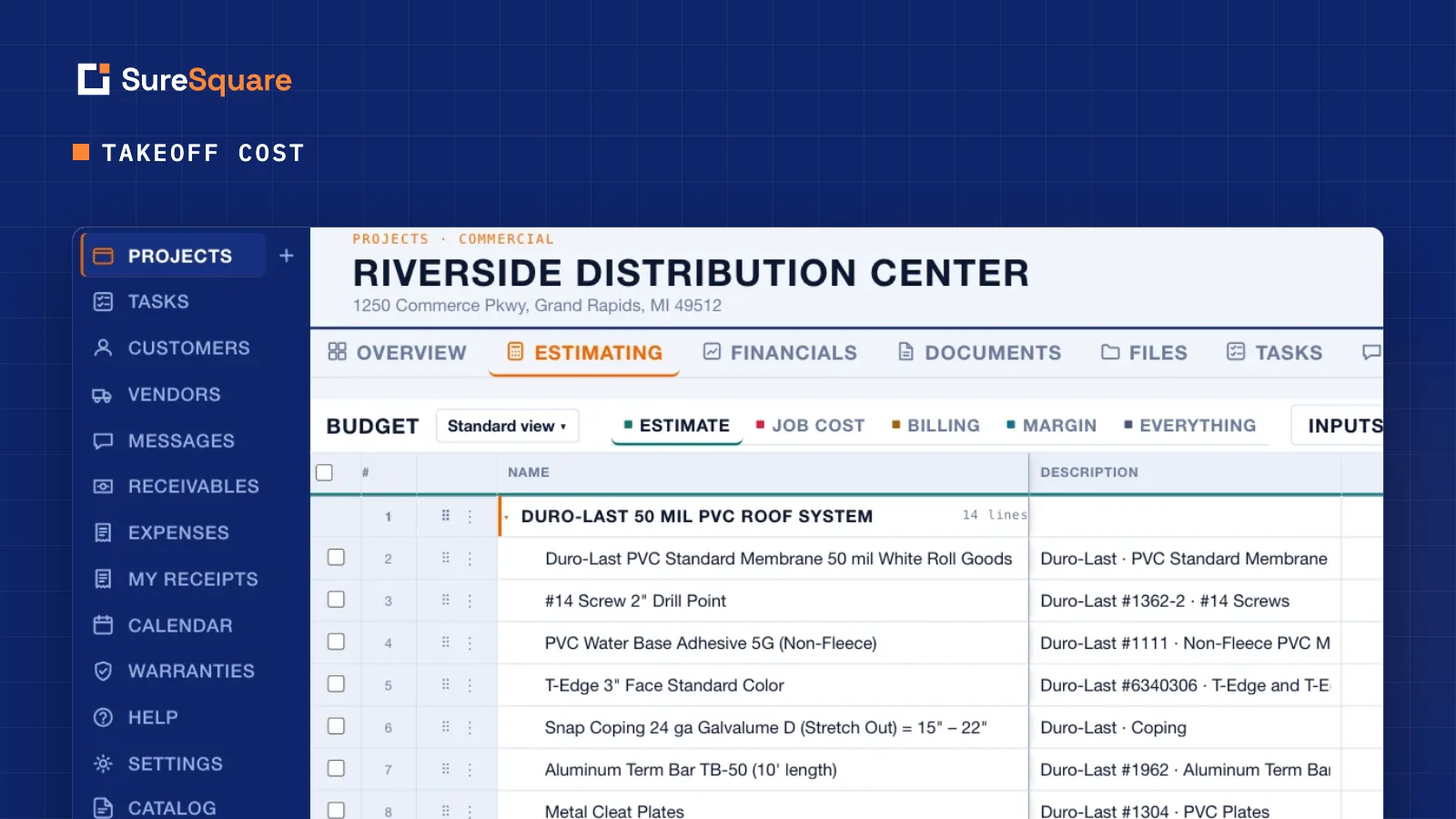
Quantities alone are the least work: squares, LF of ridge, hip, valley, eave and rake, flashing lengths and penetration counts. Turning those into a material list by system takes more. Adding labor quantities takes more again. Pay for the level you will actually use. If your own price book already converts quantities into materials, quantities are all you need.
Size and complexity
A cut-up roof with many facets, dormers and pitch changes takes longer than a simple gable of the same area. On low-slope work, multiple roof levels, many curbs and tapered insulation do the same. Some services charge extra for this. At SureSquare, a large or complex job is an $89 add-on.
Number of buildings
An apartment site with eight buildings is eight roofs, even when several share a plan. Expect a per-building charge. Ours is $29 for each extra building.
Turnaround
A takeoff needed for a bid due tomorrow costs more than one due next week, in overtime if it is in-house and in a rush fee if it is not. Rush turnaround at SureSquare is a $49 add-on. The cheap fix is to send plans the day the invitation arrives, not the day before the bid.
Revisions
Addenda change roofs. A moved drain, an added curb or a revised edge detail means the takeoff has to be updated. In-house, that is more hours. With a service, ask what a revision costs before you need one. Additional revisions at SureSquare are $29 each.
How to compare the options on a real bid
Take the last five jobs you bid and run the same three numbers for each:
- In-house: hours spent on the takeoff times loaded hourly cost.
- Subscription: one month of the fee divided by the takeoffs you ran that month, plus the hours times loaded cost.
- Per-project: the service price for that job type and level, plus any add-ons that would have applied, plus the time you spent sending plans and checking the report.
Do not skip the checking time in the third one. Whoever measures, someone on your side should review the report against the plans before the number goes in a bid. Our guide on how to check a roofing takeoff before you bid it walks through that review.
Many contractors land on a mix. Simple houses get measured in-house in a few minutes. Commercial plan sets and anything that stacks up on bid day go out. That keeps the estimator on pricing and scope, which is where the bid is won or lost.
The cost that matters most
The price of the takeoff is small next to the price of a wrong one. A missed 200 LF of wall flashing or a facet measured at the wrong pitch costs more than a year of takeoff fees, and it comes out of the job's margin. So weigh the options on two things together: what each takeoff costs you, and how likely it is to be measured carefully when you are busiest.
No takeoff replaces your own review. Quantities come from the plans provided, and field conditions can differ. Our estimating disclaimer explains what a takeoff covers and what stays with the contractor.
If you want to see what a per-project takeoff looks like on one of your own bids, SureSquare's takeoff service measures steep-slope and low-slope roofs from your plan set and returns a PDF and CSV report, priced per job with nothing to cancel. Questions can go to sales@suresquare.bid.