The crew finished the roof three weeks ago, the dumpster is gone, and the final invoice is still sitting unpaid. Meanwhile the supplier wants payment on the shingles, payroll runs Friday, and the next two jobs need material deposits before they can start.
Slow collections hurt a roofing company more than slow sales. A job that is sold but not started costs nothing yet. A job that is built but not paid has already spent your labor and material money. Most late roofing invoices are not caused by customers who refuse to pay. They come from invoices that went out late, did not match what the customer signed, or made paying harder than it needed to be.
Why Roofing Invoices Get Paid Late
Before you change anything, look at the last ten invoices that took more than 30 days to collect. The same few causes show up again and again:
- The invoice went out days or weeks after the crew finished, because the office was waiting on a final count or a foreman's notes
- The total did not match the signed proposal, and nobody had attached the change order that explained the difference
- The customer did not understand what was still owed after the deposit
- The only way to pay was a paper check mailed to the office
- Nobody owned the follow-up, so a polite reminder never went out
- On insurance jobs, the homeowner was waiting on the depreciation release and did not know what to send the carrier
Each of these is a process problem, not a customer problem. That is good news, because process problems can be fixed once and stay fixed.
Set the Payment Terms Before the Job Is Sold
The fastest invoice to collect is the one the customer already agreed to in writing. Your proposal should spell out the payment schedule in plain words, not in a paragraph of fine print.
For a residential replacement, a common structure is a deposit at signing, sometimes a payment when materials are delivered, and the balance due on completion. State the dollar amount or percentage for each payment and what event triggers it. "Balance due upon completion" is clearer to a homeowner than "net 30."
Commercial work usually runs on progress billing against a schedule of values, with retainage held until the end of the job. Agree on the billing date each month, who approves the pay application, and what documents have to come with it. Missing a general contractor's cutoff date by one day can push your payment back a full month.
Whatever the structure, put it in the proposal the customer signs. When the deposit, progress and final amounts all trace back to the same signed document, there is nothing to argue about later.
Invoice the Day the Work Is Done
Every day between the last nail and the invoice is a day added to your collection time. A homeowner who just watched a clean crew finish their roof is happy to pay. Three weeks later, the roof is just part of the house again and the invoice feels like a bill.
To invoice the same day, the office needs three things from the field before the crew leaves:
- Confirmation that the scope is complete, including cleanup and magnet sweep
- Any change orders, signed, with the quantities that were actually installed
- Completion photos of the finished roof, flashing details and the cleaned-up property
If your foreman has to drive back to the office to turn in paperwork, the invoice will always wait until tomorrow. Give the crew a way to upload photos and mark the job finished from their phone, and the office can build the invoice that afternoon.
Make the Invoice Match the Contract
An invoice that does not match the proposal stops payment cold. The customer sees a number they do not recognize and sets the invoice aside until they can call you. That call often does not happen for a week.
A clean roofing invoice shows:
- The original contract amount from the signed proposal
- Each approved change order as its own line, with a short description
- Payments already received, with dates
- The balance due now, in large type
- How to pay and when payment is due
Change orders are where most mismatches start. If the crew replaced 14 sheets of decking and the contract priced decking per sheet, the invoice should say 14 sheets at the contract rate, and the customer should have already signed for it. Our article on getting paid for roofing change orders covers how to document that work in the field.
Building invoices from the same estimate and proposal you sold from removes most of this risk. When the invoice pulls its lines from the signed document instead of being retyped, the numbers cannot drift.
Make Paying as Easy as Possible
If the only way to pay you is a check in the mail, you are adding a week to every invoice. The check has to be written, mailed, opened, logged and deposited. Any one of those steps can stall.
Let customers pay online by card or ACH bank transfer. Homeowners are used to paying everything else from their phone. A link in the invoice email that opens a payment page gets paid faster than a mailing address at the bottom of a PDF.
Card fees are a real cost, so decide your policy before you turn it on. Some contractors accept cards on deposits and smaller repair invoices and steer larger balances to ACH, where fees are usually lower. Whatever you decide, write it into the payment terms so the customer is not surprised.
A customer portal helps too. When the homeowner can log in and see the signed proposal, the change orders, the photos and the invoice in one place, they have everything they need to approve the payment without calling the office to ask for a copy.
Give Collections an Owner and a Schedule
Unpaid invoices get collected when one person is responsible for them and works from a list every week. That person does not need to be a full-time bookkeeper. In most small roofing companies it is the office manager, and it takes an hour or two a week if the list is accurate.
A simple follow-up schedule works for most residential jobs:
- Day 0: Invoice sent the day the job is finished, with completion photos
- Day 7: A friendly note asking if they have any questions about the invoice
- Day 15: A phone call. Most slow payers have a question they have not asked
- Day 30: A firm written reminder that states the amount, the due date and the contract terms
- Day 45 and beyond: Talk to the owner about next steps, including lien deadlines
Mechanic's lien rules and notice deadlines are set by each state and are strict. Learn the deadlines for every state you work in before you need them, and have your attorney review your notice process. A missed preliminary notice can cost you the right to file a lien at all.
Insurance jobs need their own step
On insurance work, the homeowner often cannot pay the final balance until the carrier releases the recoverable depreciation. The carrier usually needs the final invoice and proof of completion first. Send the homeowner a copy they can forward, with the completion photos, the day the roof is done. Then check in with them a week later to see whether the carrier has what it needs. Waiting for the homeowner to figure it out alone is how insurance balances drift past 90 days.
Watch Receivables as a Number, Not a Feeling
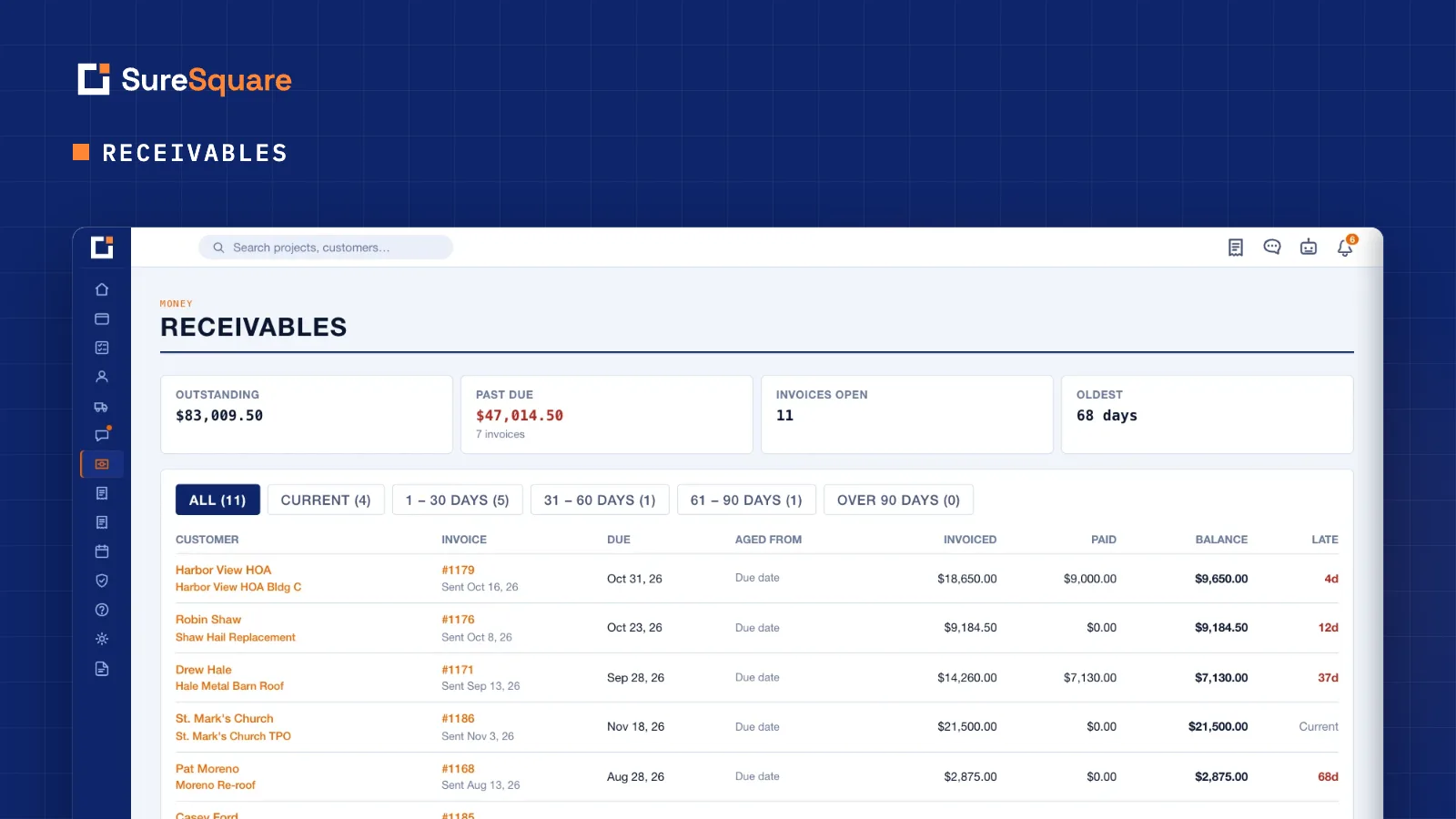
Most roofing owners can tell you how much they sold last month. Fewer can tell you, without opening three spreadsheets, how much is owed to them right now and how old it is.
Look at receivables every week. Sort open invoices by age and by job. The total matters, but the oldest invoices matter more. A $4,000 balance at 75 days deserves more attention than a $20,000 balance that went out yesterday.
Watch for patterns too. If one salesperson's jobs always collect slowly, the payment terms may not be explained clearly at the kitchen table. If commercial jobs routinely run past 60 days, look at how pay applications are submitted. The receivables list tells you where the process is breaking.
Bring It Together in One System
Collections get faster when the proposal, change orders, photos, invoices and payments live in the same place. The office is not hunting for a signed change order in an email thread, the crew's completion photos are already attached to the job, and the receivables list is current without anyone rebuilding it by hand.
SureSquare CRM follows a roofing job from the first call to the final invoice. Proposals are e-signed, invoices are built as documents on the job, customers can pay by card or ACH, and the customer portal gives homeowners their documents, messages and progress in one login. See CRM pricing for current plans, or write to sales@suresquare.bid with questions about how your office handles billing today.