A reroof bid that only measures the new roof is missing half the job. Tear-off, disposal, rotten deck, wet insulation and curbs that end up too short after the new system goes on all cost money, and none of them show up if you take off the reroof like new construction.
This guide covers what a reroof takeoff needs beyond the new roof area: what to count for tear-off, what to count for a recover, and how to carry the unknowns so they do not come out of your margin.
Decide the scope before you measure
The first question on any reroof is whether the existing roof comes off or stays. The answer changes almost every quantity on the takeoff.
- Full tear-off. Everything comes off to the deck. You count removal by layer, disposal, deck repair, and a complete new system from the deck up.
- Recover. The existing roof stays and the new system goes over it. You count recover board, fasteners long enough to reach the deck, and the areas of wet material that still have to be cut out.
- Partial tear-off. Some roof areas come off and some are recovered. Each area gets its own scope, and the takeoff has to keep them separate.
Building code generally limits how many roof layers a building can carry, and the existing roof has to be dry and sound to recover over it. The spec, the designer or the local building department decides which scope applies. Do not assume a recover because it prices lower.
What to count for a tear-off
Tear-off is measured by roof area, but the area is only the start. The labor and the dumpster count depend on what is coming off.
- Removal area by roof section. Measure it the same way you measure the new roof, by area and by level. On steep-slope work, carry it in squares at true area, adjusted for pitch, not plan area.
- Number of layers. Two layers of shingles take more labor and more dumpster space than one. Note the layer count for each roof area. If you do not know it, carry it as an assumption on the bid.
- What each layer is. Shingles, built-up roof with gravel, mod-bit, single-ply, wood shakes or slate all tear off and haul differently. Ballasted single-ply means handling and hauling stone as well as membrane.
- Insulation coming off. On low-slope work, a full tear-off usually removes the insulation too. Note its thickness, because it drives disposal volume.
- Flashing and metal removal. Old base flashing, counterflashing, coping, edge metal and drip edge all come off. The linear feet you measure for new metal are the same linear feet you remove.
- Disposal. Dumpster loads come from removal area, layer count and material weight. Keep the disposal line separate so it can be checked against the haul tickets later.
Deck replacement is a quantity, not a guess
Nobody knows how much deck is rotten until the old roof is off. That is exactly why it needs its own line on the takeoff instead of a number buried in the waste factor.
The usual way to handle it is a stated allowance: a number of sheets of plywood or OSB on a steep-slope roof, or square feet of deck on a low-slope roof, at a unit price. Anything over the allowance becomes a change order at the same unit price. Write the allowance and the unit price into the proposal so the homeowner or the owner sees it before the job starts.
On low-slope work, check the spec for metal deck repair, wood nailer replacement and any deck fastening the new system requires. Those are separate from sheet replacement.
What to count for a recover
A recover skips most of the tear-off, but it adds quantities of its own.
- Recover board. Most single-ply recovers go over a cover board or recover board. Count it in boards from the field area, with waste for cuts at the perimeter and penetrations.
- Fastener length. The fastener has to pass through the new system, the recover board, the existing roof and the existing insulation and reach the deck. Longer fasteners and the plates that go with them are a real cost. Fastener counts per board usually go up at the perimeter and corners, per the manufacturer's pattern.
- Wet area removal and replacement. Wet insulation cannot stay under a new roof. If there is a moisture survey or core cuts, the wet areas get measured, cut out and replaced with new insulation to match the existing thickness.
- Existing surface prep. Gravel on a built-up roof may need to be removed, and blisters or ridges cut and leveled, before the new system goes down.
- Flashing. Most recovers still tear out the old base flashings at walls and curbs. Measure the wall and curb linear feet the same way you would on new work.
Raised heights change the flashing and the metal
This is the miss that shows up on almost every low-slope reroof. Adding insulation, a recover board or a tapered package raises the finished roof surface. When the roof goes up, everything that sticks through it has to be checked.
- Curbs. Most specs and manufacturers set a minimum flashing height above the finished roof. If the curbs on rooftop units, hatches or skylights end up too short, they need curb extensions, and those are often a separate trade or a separate line.
- Parapet walls. The base flashing runs higher, and the coping or counterflashing may need to be raised or replaced to cover it.
- Roof edge. A thicker roof needs taller wood nailers at the edge and edge metal with a deeper face.
- Drains. Drains may need extension rings or replacement so the drain bowl sits at the new roof level. Count each drain and note what it needs.
- Door thresholds and windows. A roof door or a window close to the roof can end up too low once the roof goes up. Flag it so it gets resolved before the bid.
Our flashing and edge metal takeoff checklist covers how to measure the linear feet. On a reroof, the added question is how tall each of those details now has to be.
What to ask for before the takeoff
A new building has a full plan set. A reroof often has less to measure from, so collect what exists before anyone measures.
- The reroof drawings and spec from the designer, if there are any.
- The original building drawings, especially the roof plan, roof details and structural deck notes.
- Any moisture survey, infrared scan or core cut results, with the wet areas marked.
- Notes on existing layers and material, from a site visit or the owner.
- Photos of curbs, drains, walls and edges, so the estimator can see heights and conditions.
The more of this you have, the fewer assumptions the bid has to carry.
Carry the unknowns in writing
Every reroof has quantities that cannot be known until the roof is open. The difference between a profitable reroof and a losing one is usually whether those unknowns were written down.
- State the layer count you priced. If you found more layers, extra removal is extra work.
- State the deck allowance and unit price. Sheets beyond it are billed at that price.
- State the wet insulation quantity you priced. If the survey missed areas, replacement beyond that quantity is extra.
- List exclusions plainly. Curb extensions, structural repairs, asbestos testing or abatement, and mechanical disconnects are common ones.
Keep these as separate lines on the takeoff and the estimate, not as a bigger waste factor. A waste factor covers cuts and laps. It does not cover a second layer of shingles nobody knew about.
A quick reroof takeoff checklist
- Scope set by roof area: tear-off, recover or partial.
- Removal area by section, with layer count and material type.
- Disposal as its own line.
- Deck replacement allowance with a unit price.
- Recover board and fastener length checked against total roof thickness.
- Wet insulation areas measured from the survey or core cuts.
- Curb, parapet, edge and drain heights checked against the new roof level.
- Old flashing and metal removal counted alongside the new.
- Assumptions and exclusions written into the bid.
Getting a reroof measured
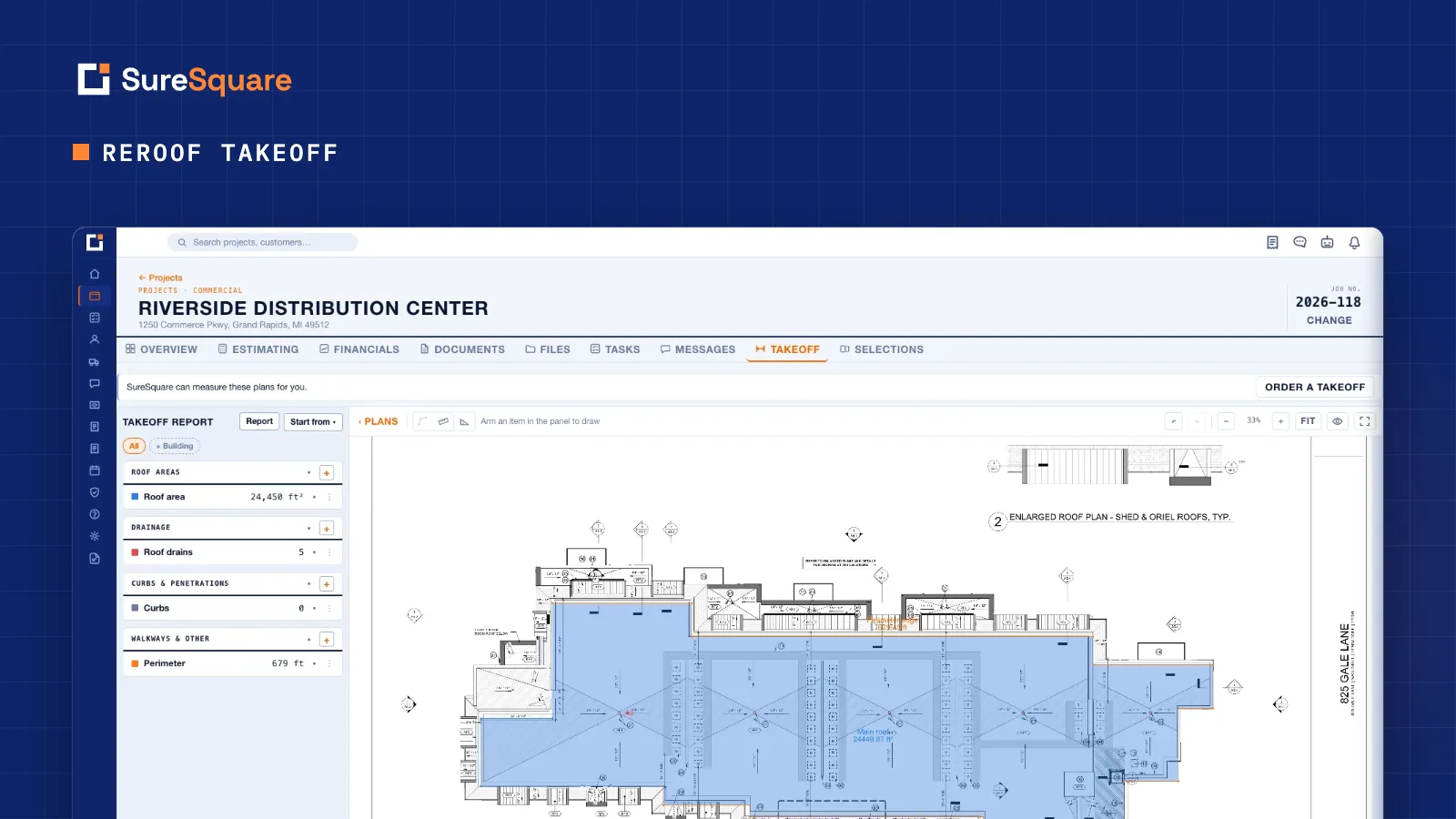
The SureSquare takeoff service measures steep-slope and low-slope roofs from the plan set you send, residential and commercial, and returns a PDF and CSV report you can price from. For a reroof, send the drawings you have along with any survey and photos and tell us which areas are tear-off and which are recover. Pricing is per project with no subscription; the service levels are on the takeoff pricing page. Every quantity should still be checked against field conditions before you order, which our estimating disclaimer explains.