A plan set lands at 3:30 p.m., the bid is due tomorrow, and your estimator is already tied up on two active proposals. That is where outsourced roofing estimating earns its place. It gives your team a way to turn plans into usable roofing quantities without rushing measurements, delaying a bid, or pulling a project manager off an active job.
The value is not simply having someone else count squares. A useful takeoff gives the estimating team a defensible starting point: roof area by section, pitch per facet, ridges, hips, valleys, perimeters, penetrations, drains, curbs, and waste factors that match the system being priced. Your team still owns the bid strategy, labor assumptions, exclusions, and final number. The measurement bottleneck no longer owns the schedule.
When Outsourced Roofing Estimating Makes Sense
Most roofing contractors do not need to outsource every takeoff. A repeat customer with a simple reroof, clean aerial imagery, and a field-verified scope may be faster to handle internally. The case changes when the plans are dense, the roof has multiple systems, or bid volume starts exceeding the capacity of the person doing measurements.
Outsourcing is especially practical when a commercial plan set includes low-slope areas, tapered insulation, parapet walls, drains, flashings, and multiple detail sheets. It also helps on steep-slope work with complex geometry, numerous pitch changes, dormers, valleys, and accessory structures. These are the scopes where a missed facet or an incorrect linear-foot count can move material cost enough to erase the margin you thought you had.
Bid deadlines are another clear trigger. Owners and estimators often try to solve a capacity problem by working later. That approach can work for a week. It does not work as a process. Fatigue creates bad inputs, and bad inputs create a bid that looks competitive until the purchase order exposes the gap.
Outsourced support also gives growing companies a way to bid more work before adding a full-time estimator. That is not a reason to bid every job that comes through the door. It is a way to review more qualified opportunities without turning plan measurement into the limiting factor.
What a Bid-Ready Roofing Takeoff Should Include
A report is only useful if it can be checked and priced. A single roof-area number is not enough for most scopes. Your estimator needs quantities that connect to the material system, installation method, and labor plan.
For steep-slope roofing, that typically means roof area in SQ, pitch per facet, eaves, rakes, ridges, hips, valleys, wall flashing, penetrations, and the quantities needed for the selected shingle, metal, tile, or specialty system. Waste should not be a blind percentage applied across the entire roof. Valleys, cut-up sections, steep pitches, and material format all affect what is reasonable.
For low-slope and flat roofs, the takeoff should separate field area from details. That includes roof area, perimeter LF, parapet conditions, base flashing, coping where applicable, drains, scuppers, pipes, curbs, expansion joints, and other penetrations. If insulation, cover board, or tapered packages are part of the scope, the report should identify the quantities clearly enough for pricing and supplier review.
The format matters, too. A PDF is useful for reviewing the marked plan and verifying where quantities came from. A CSV is useful when quantities need to move into an estimating worksheet, material order, or job-cost system. If your team has to retype every number, the takeoff saved time in one place and created administrative work in another.
Human Review Is the Difference on Complex Roofs
Automated tools can be helpful for screening opportunities or checking simple geometry. They are not a substitute for reading the scope, identifying roof transitions, and recognizing when a detail changes the quantity. Plans are not always clean. Notes can conflict. Architectural drawings may show one condition while roof plans show another.
A roofing estimator can flag assumptions instead of quietly turning ambiguity into a number. That matters when a roof has phased areas, alternates, demolition limits, multiple membrane assemblies, or unclear responsibility for flashings and accessories. The right output is not false certainty. It is measurable quantities paired with clear notes your team can review before submitting the bid.
A Practical Workflow for Outsourced Estimating
The handoff should be simple enough that it does not create a new layer of office work. Start by sending the current plan set, addenda, relevant specifications, and bid due date. If there is a bid form, scope sheet, or known material system, include that as well. An estimator cannot measure a detail that was never provided.
Next, define what you need measured. A residential contractor may need a steep-slope quantity report with facets, pitch, waste factors, and all major LF items. A commercial contractor may need field areas broken out by roof zone, along with perimeters, drains, penetrations, and insulation-related quantities. The request should match how your company buys material and builds estimates.
When the report is returned, assign a real review step. Check the marked plans against the proposal scope, compare key quantities to field knowledge or historical jobs, and look at the assumptions. Review is not busywork. It is how you catch a missing alternate, a plan revision, or a scope item the estimator could not reasonably infer from the documents.
Then price the work using your own production rates, supplier costs, crew capabilities, overhead, and desired margin. A takeoff is an input, not a completed bid. The contractor who understands local labor conditions, access constraints, customer expectations, and competitive pressure should make the final commercial decision.
Where Contractors Lose Value
The cheapest takeoff is not always the lowest-cost option. If a report is late, hard to read, or incomplete, your estimator still has to rebuild it. That can cost more than doing the measurement internally from the start.
Be cautious of services that provide only an area number or rely entirely on automated measurements without plan-level review. Those outputs can be useful as a quick check, but they rarely cover the details that drive a roofing proposal. Perimeter flashing, valley metal, drain work, edge conditions, and penetrations do not price themselves.
Another common problem is treating the outsourced estimator as the scope writer. They can measure what is shown, but they cannot decide whether your proposal should include decking replacement allowances, permits, crane costs, rooftop protection, occupied-building logistics, or exclusions for concealed conditions. Those decisions stay with the contractor.
Turnaround expectations also need to be realistic. A straightforward residential roof and a multi-building commercial reroof should not be treated as the same request. Faster delivery can be valuable, but only if the measurement process still accounts for plan complexity and quality review.
Make the Takeoff Part of the Job Record
The best operations teams do not let a takeoff disappear after the bid goes out. They retain the PDF, CSV, proposal version, supplier quote, and scope notes with the opportunity. If the project is awarded, those documents become a useful handoff package for procurement, the project manager, and the field team.
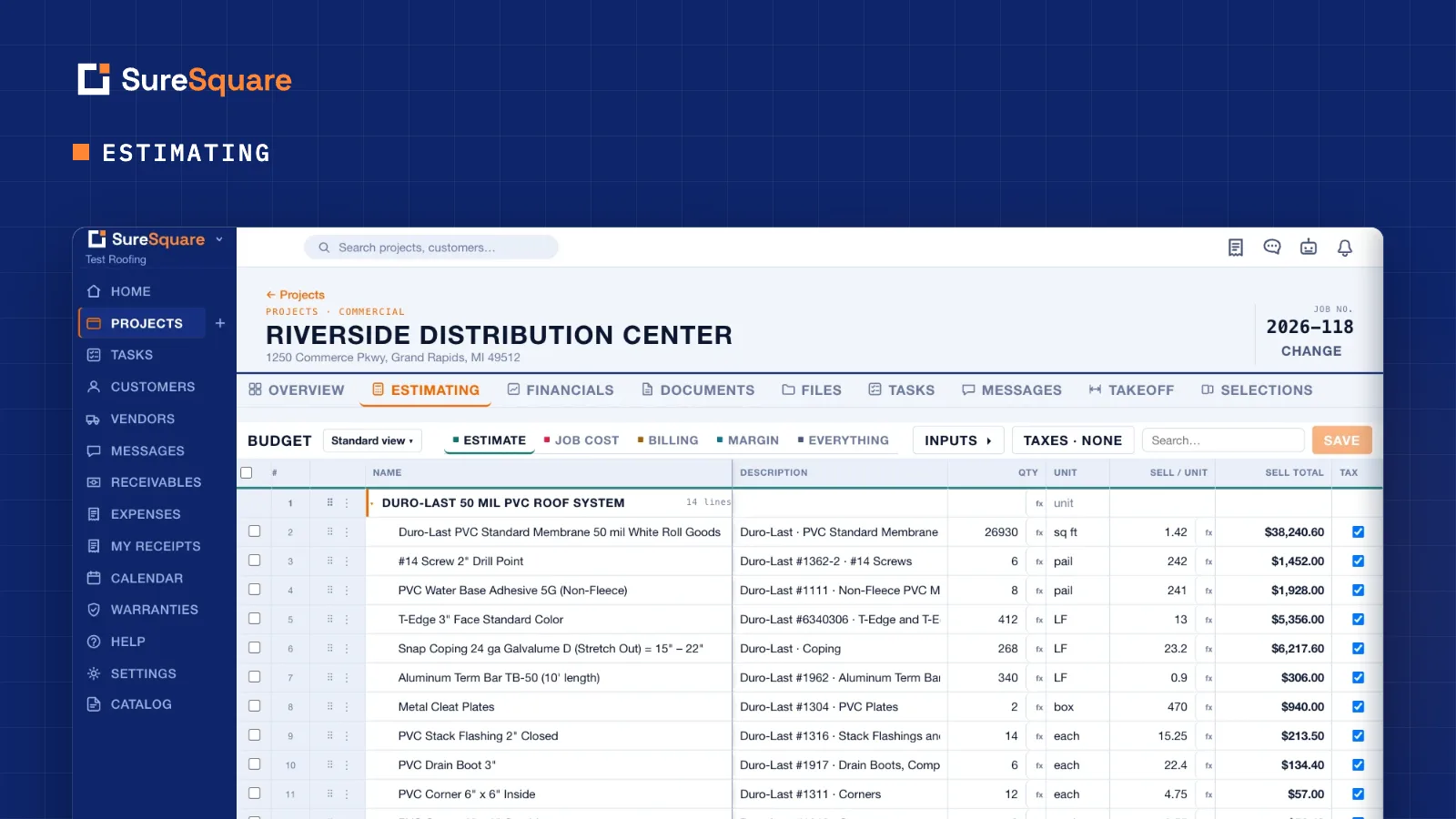
This is where roofing-specific workflow software can reduce friction. SureSquare allows contractors to use takeoff services independently or keep leads, estimates, proposals, scheduling, timesheets, invoices, and customer communication in one operating system. The point is not to force every contractor into one process. It is to keep the numbers used to win the work available to the people responsible for delivering it.
A clean job record also improves post-job review. When actual material usage or labor misses the estimate, you can trace the issue. Was the takeoff wrong? Was the scope revised? Did waste run high because of access, cuts, or sequencing? Or was the pricing assumption too light? Without the original quantities and notes, that conversation becomes guesswork.
Questions to Ask Before You Send Plans
Before choosing an estimating partner, ask whether the work is measured by experienced human roofing estimators, what report formats are delivered, and how assumptions or missing information are documented. Ask whether the service handles both steep-slope and commercial low-slope scopes, not just basic roof area.
You should also ask how revisions are handled and whether the turnaround matches the kinds of opportunities you pursue. A partner may be a strong fit for plan-driven commercial work but not emergency residential estimates, or vice versa. The goal is not a generic resource. It is dependable capacity that fits your bid process.
Send complete plans, state the system you are pricing when known, and protect time for a final scope review. Done that way, outsourced estimating gives your team more than faster measurements. It gives them room to make better bid decisions before the deadline decides for them.