A crew can be on the clock for ten hours and still leave an owner with no clear answer about where the labor went. Was the time spent on tear-off, dry-in, flashing details, material runs, warranty work, or a job that was not supposed to have anyone there? GPS timesheets for roofers put a job location and a time record behind every shift, giving operations teams a more defensible labor picture before payroll is approved.
That does not mean GPS replaces supervision or turns a foreman into an app operator. It gives the office a cleaner starting point: who arrived, which job they were assigned to, when they left, and how many labor hours landed against the scope. For contractors managing multiple crews, service calls, and jobs spread across a metro area, that record can protect margin quickly.
Why Roofing Labor Needs Job-Level Tracking
Roofing labor is rarely simple clock-in, clock-out work. A crew may start at a supplier, move to a steep-slope reroof, send two installers to handle a missing shingle call, then finish the day cleaning up a commercial low-slope project. If every hour is entered later from memory, payroll may be correct enough while job costing is wrong.
That matters when you are comparing estimated labor to actual labor. A bid may carry a labor allowance based on roof area, pitch per facet, tear-off layers, access, penetrations, and expected waste factors. If the labor record only says “Crew A - 42 hours,” there is no useful way to determine whether the overage came from a complex valley layout, a delayed delivery, extra decking repairs, or poor crew allocation.
GPS-backed time entries tie labor to the place where it was performed. When the crew is scheduled against a specific job, office staff can review hours alongside the estimate, proposal, production notes, change orders, and invoice. The goal is not surveillance for its own sake. The goal is to stop labor from becoming an untraceable overhead number.
What GPS Timesheets Should Capture
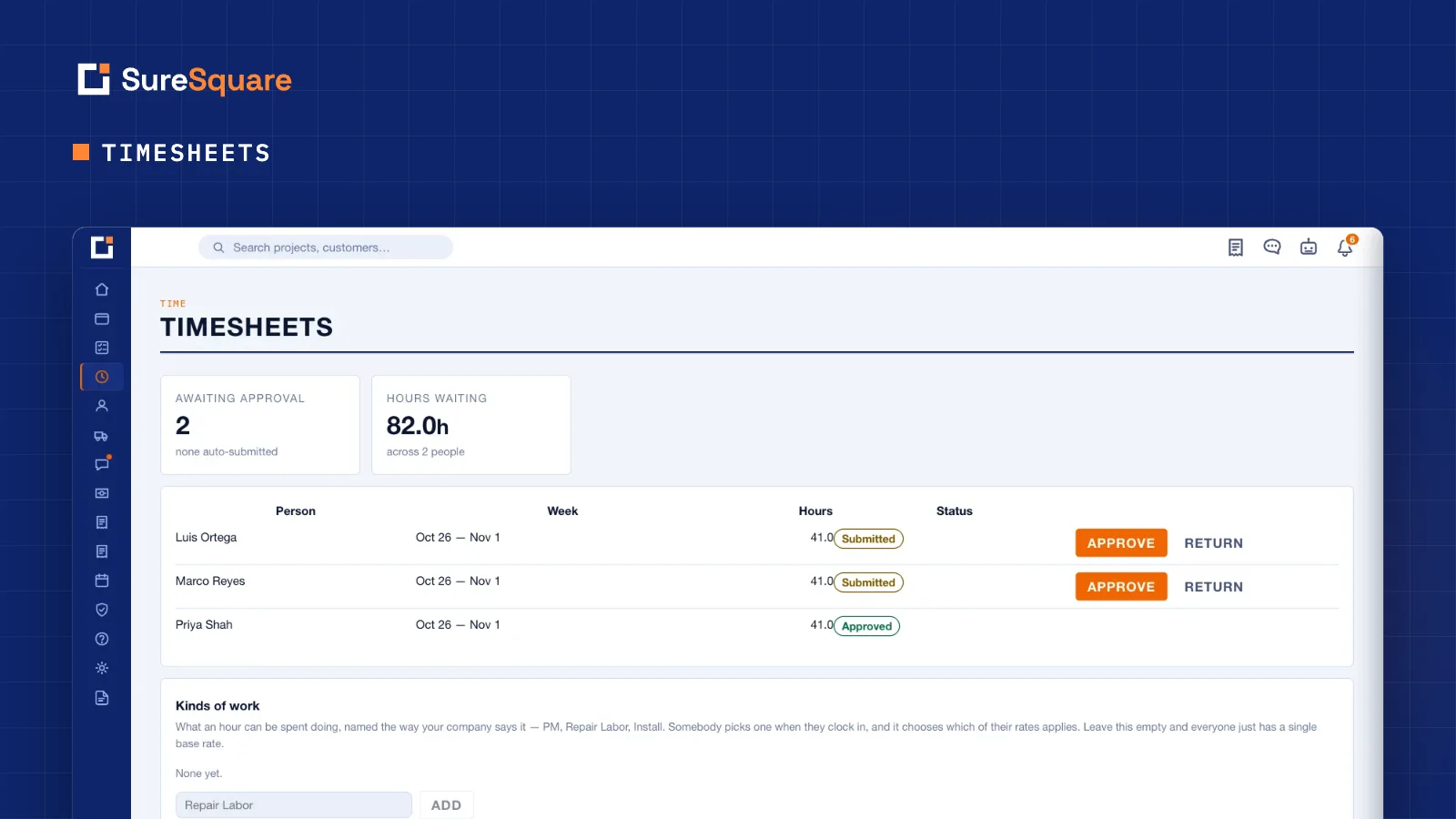
A useful roofing timesheet needs more than a map pin. At a minimum, it should record the employee or crew member, clock-in and clock-out time, assigned job, and location data tied to the event. It should also make it easy to correct mistakes with an approval trail. Phone batteries die, addresses can be entered wrong, and a crew may clock in from the driveway instead of the roof.
The best workflow also separates travel, production, and non-job time when that level of detail is needed. A contractor that pays drive time differently from install time needs that distinction. So does a company trying to identify whether labor loss is happening on the roof or between jobs.
For production work, job codes should match how the business actually reviews performance. A residential contractor may want tear-off, install, punch, and service categories. A commercial contractor may need separate codes for demo, insulation, cover board, membrane, flashing, drains, and warranty repairs. Do not build a timekeeping structure so detailed that foremen stop using it. Capture the data you will actually review.
Geofencing Can Reduce Bad Entries
Geofencing creates a virtual boundary around a jobsite and can flag time entries outside that area. It is helpful when crews regularly move among active jobs, but the boundary needs common sense. A tight fence around a downtown building may exclude legal parking, a material staging area, or a laydown yard.
Set a radius that reflects the site conditions. Then let managers review exceptions instead of automatically treating every exception as a timecard problem. GPS is evidence, not a substitute for context.
How GPS Timesheets Improve Job Costing
Labor is often the first place a roofing job loses margin without obvious warning. Material costs show up on supplier invoices. Dump fees appear on tickets. Labor can disappear inside a weekly payroll total unless hours are posted to the correct job.
With location-based timesheets, a project manager can compare actual crew hours against the production plan while the job is still open. If a 35 SQ architectural shingle reroof was budgeted for 120 labor hours and has already consumed 105 hours before ridge cap and cleanup, the team can investigate before the final margin report arrives.
The answer may be legitimate. A steep 10/12 pitch, two layers, extensive chimney flashing, or hidden decking damage can change the labor requirement. In that case, the record supports a change order, a revised production expectation, or better assumptions on the next similar bid. If there is no documented reason, the owner has a different conversation to have with the production team.
Over time, those records improve estimating. You can see whether certain roof systems, crews, municipalities, or scope conditions consistently run high on labor. Estimators can then adjust labor units instead of relying on a flat rate that does not reflect the work. That is the connection between field administration and margin protection.
A Practical Rollout for Roofing Crews
The fastest way to make GPS time tracking fail is to launch it as a disciplinary tool with no clear process. Crews need to know when to clock in, what job to select, what happens when they move sites, and who can correct an error. Office staff need to know who approves timecards and when payroll locks.
Start with active crews and active jobs rather than loading every historical customer record into the system. Confirm job addresses, assign each worker to the right crew, and set a standard for clocking in and out. A simple rule works best: clock in when work starts, select the job, clock out when work ends, and notify the foreman or office if the location is wrong.
Train foremen on the few situations that cause most bad records: supplier stops, shared crews, emergency service calls, weather delays, and overnight commercial work. If a crew splits between jobs, each group needs a clear job assignment. If the foreman is the only person expected to manage the whole crew’s time, define that responsibility before payroll week.
For the first few pay periods, review exceptions daily instead of waiting until Friday afternoon. You will catch duplicate clock-ins, inactive job assignments, and geofence settings that are too tight. Small corrections early are easier than rebuilding a week of payroll from text messages and handwritten notes.
Privacy, Policy, and Trust
GPS tracking touches employee privacy, so contractors should use a written policy and apply it consistently. Tell employees what is collected, when it is collected, why it is collected, who can review it, and how long records are retained. In most cases, tracking should be limited to working time and company-approved devices or agreed-upon mobile use.
Avoid vague language such as “we can track you at all times.” The business purpose is timekeeping, job verification, dispatch, and labor costing. Keep the policy aligned with that purpose. State and local requirements can differ, so have counsel or an HR professional review the policy for your operating areas.
Trust also depends on fair corrections. GPS can be inaccurate around large buildings, rural sites, poor cell coverage, and dense urban areas. Workers need a straightforward way to explain an exception, and managers need a consistent approval process. A system that assumes every flagged entry is misconduct will create resistance and bad data.
Where GPS Timesheets Fit in the Roofing Workflow
GPS timesheets work best when they are connected to the rest of the job record. The sales team creates the opportunity. The estimator builds the scope and quantities. The proposal is approved. Production schedules the crew. Then the labor record attaches to the same job instead of living in a separate spreadsheet.
That connection keeps the office from reconciling names, addresses, and job numbers across disconnected tools. It also gives project managers a clearer view of labor before invoicing and closeout. SureSquare's roofing CRM is built around that workflow, with crew scheduling and GPS timesheets alongside estimates, proposals, invoicing, and customer communication.
A timesheet will not fix a weak estimate, a short-handed crew, or a roof that reveals unexpected conditions after tear-off. It will give you a timely record of what happened. That is enough to approve payroll with confidence, ask better production questions, and price the next job with fewer assumptions.